 LOWIFAR CERAMIC
Ceramic bearings are increasingly used in demanding applications where conventional steel bearings cannot provide sufficient performance. Thanks to their excellent corrosion resistance, electrical insulation, lightweight construction, low thermal expansion, and high-speed capability, ceramic bearings have become the preferred choice in industries such as semiconductor manufacturing, food processing, medical equipment, chemical processing, aerospace, and electric motors.
While selecting the appropriate ceramic material is essential, bearing internal clearance is equally important. Choosing the correct clearance helps ensure smooth operation, minimizes friction, improves rotational accuracy, and extends bearing service life.
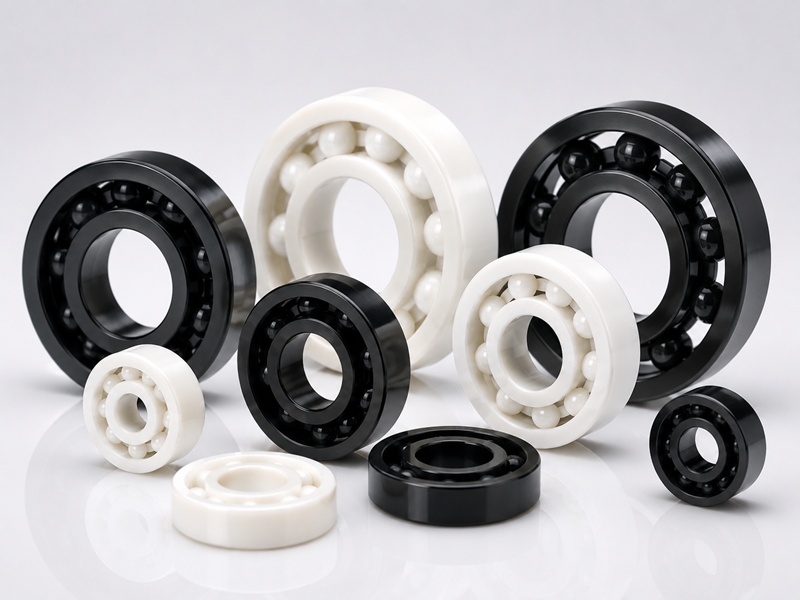
What Is Bearing Internal Clearance?
Internal clearance is the total distance one bearing ring can move relative to the other before installation.
There are two types of bearing clearance:
- Radial Internal Clearance – Movement perpendicular to the shaft.
- Axial Internal Clearance – Movement parallel to the shaft.
For deep groove ceramic ball bearings, radial internal clearance is the specification most commonly considered during bearing selection.
After installation, the actual operating clearance changes due to shaft interference, housing fit, thermal expansion, and operating loads.
Why Clearance Is Especially Important for Ceramic Bearings
Compared with conventional steel bearings, ceramic bearings exhibit significantly different material properties.
Lower Thermal Expansion
Ceramic materials such as silicon nitride (Si₃N₄), zirconia (ZrO₂), and silicon carbide (SiC) have much lower coefficients of thermal expansion than steel.
This means:
- Bearing dimensions remain more stable at elevated temperatures.
- Operating clearance changes less during temperature fluctuations.
- Higher dimensional accuracy can be maintained during continuous operation.
Because ceramic components expand less than steel, the clearance selection for hybrid ceramic bearings and full ceramic bearings may differ from traditional steel bearings.
Higher Rotational Speed
Ceramic balls are approximately 40–60% lighter than steel balls.
The reduced centrifugal force allows:
- Higher operating speeds
- Lower vibration
- Reduced heat generation
- Longer bearing life
For high-speed applications, proper clearance helps prevent excessive preload caused by temperature rise.
Corrosion-Resistant Applications
Many ceramic bearings operate without lubrication in chemically aggressive environments.
Proper clearance ensures smooth rolling motion while minimizing friction under dry-running conditions.
Common Bearing Clearance Classes
Ceramic deep groove ball bearings are generally available in the following clearance classes:
| Clearance Class | Description | Typical Applications |
|---|---|---|
| C2 | Smaller than normal | Precision instruments |
| CN (Normal) | Standard clearance | General industrial equipment |
| C3 | Greater than normal | High-speed motors and pumps |
| C4 | Greater than C3 | High-temperature or heavy-duty equipment |
| C5 | Largest clearance | Specialized industrial applications |
Recommended Clearance for Different Ceramic Bearing Applications
CN (Normal Clearance)
Normal clearance is suitable for most standard operating conditions.
Typical applications include:
- Food processing equipment
- Medical devices
- Packaging machinery
- Laboratory equipment
- Semiconductor handling systems
CN clearance provides an excellent balance between running accuracy and service life.
C3 Clearance
C3 is one of the most commonly selected clearance classes for ceramic bearings.
Recommended for:
- High-speed electric motors
- Vacuum pumps
- Textile machinery
- Industrial fans
- Spindles
- Hybrid ceramic bearings
Advantages include:
- Compensation for thermal expansion
- Reduced operating temperature
- Lower running torque
- Improved high-speed stability
Most hybrid ceramic bearings with steel rings and Si₃N₄ balls use C3 clearance for motor applications.
C4 Clearance
C4 clearance is generally used under severe operating conditions.
Suitable applications include:
- High-temperature furnaces
- Heavy industrial equipment
- Continuous high-speed operation
- Chemical processing machinery
Larger clearance prevents excessive preload when thermal growth becomes significant.
Clearance Selection for Different Ceramic Bearing Types
Full Ceramic Bearings
Full ceramic bearings feature ceramic rings and ceramic balls.
Since ceramic materials expand much less than steel:
- CN clearance is sufficient for many applications.
- High-temperature applications may still require C3 clearance.
- Extremely high-speed applications should be evaluated individually.
Hybrid Ceramic Bearings
Hybrid ceramic bearings combine steel rings with silicon nitride balls.
Because the steel rings expand more than the ceramic balls:
- C3 clearance is commonly recommended.
- Electric motors often benefit from C3 clearance.
- High-speed spindle applications may require customized clearance.
Factors Affecting Clearance Selection
When selecting the internal clearance of ceramic bearings, engineers should consider several key operating conditions.
Operating Temperature
Higher temperatures reduce operating clearance.
For applications exceeding approximately 120°C, larger initial clearance is often recommended.
Rotational Speed
High-speed operation generates additional heat.
Applications with very high RPM generally perform better with C3 clearance.
Fit Between Shaft and Housing
Heavy interference fits reduce internal clearance after mounting.
If tight shaft fits are required, selecting C3 clearance may prevent excessive preload.
Lubrication Method
Ceramic bearings may operate:
- Grease lubricated
- Oil lubricated
- Dry running
Dry-running applications typically require careful clearance selection to minimize friction and wear.
Typical Application Recommendations
| Application | Recommended Clearance |
|---|---|
| Electric motors | C3 |
| High-speed spindle | C3 or customized |
| Vacuum pumps | C3 |
| Food machinery | CN |
| Medical equipment | CN |
| Semiconductor equipment | CN |
| Chemical pumps | CN or C3 |
| Textile machinery | C3 |
| High-temperature equipment | C4 |
Consequences of Incorrect Clearance
An unsuitable clearance can significantly reduce bearing performance.
Clearance too small
- Increased friction
- Excessive heat generation
- Higher torque
- Premature bearing failure
- Reduced service life
Clearance too large
- Increased vibration
- Higher running noise
- Reduced rotational accuracy
- Uneven load distribution
- Lower bearing stiffness
Selecting the correct clearance ensures optimal bearing performance under actual operating conditions.
LOWIFAR Ceramic Bearing Solutions
LOWIFAR manufactures a wide range of ceramic bearings designed for demanding industrial applications.
Our product range includes:
- Full Silicon Nitride Bearings (Si₃N₄)
- Full Zirconia Bearings (ZrO₂)
- Full Silicon Carbide Bearings (SiC)
- Hybrid Ceramic Bearings
- Deep Groove Ball Bearings
- Angular Contact Bearings
- Customized bearing clearances (C2, CN, C3, C4, C5)
- Open, ZZ, and Sealed Designs
Our engineering team can recommend the most suitable clearance based on operating speed, temperature, load, lubrication, and installation conditions.
Conclusion
Internal clearance is one of the most critical parameters affecting the performance and longevity of ceramic bearings. Due to the unique thermal and mechanical properties of ceramic materials, clearance selection should be based on the specific application rather than following the same guidelines used for conventional steel bearings.
By considering factors such as bearing type, operating temperature, rotational speed, shaft fit, and lubrication, users can maximize the advantages of ceramic bearings while achieving higher reliability, lower maintenance costs, and longer service life.