 CÉRAMIQUE LOWIFAR
The Growing Demand for Precision Ceramic Flange Parts
As modern industries continue to push the boundaries of performance, fiabilité, and operational efficiency, traditional metal components are increasingly being challenged by advanced engineering ceramics. Among these specialized components, Precision Ceramic Flange Parts have become a critical solution for applications requiring exceptional wear resistance, résistance à la corrosion, electrical insulation, and dimensional stability.
Precision ceramic flanges are widely utilized in semiconductor manufacturing, le traitement chimique, équipements médicaux, aerospace systems, energy technologies, and high-precision machinery. Their ability to operate in extreme environments where conventional metals may fail makes them an increasingly important component in modern industrial systems.
What Are Precision Ceramic Flange Parts?
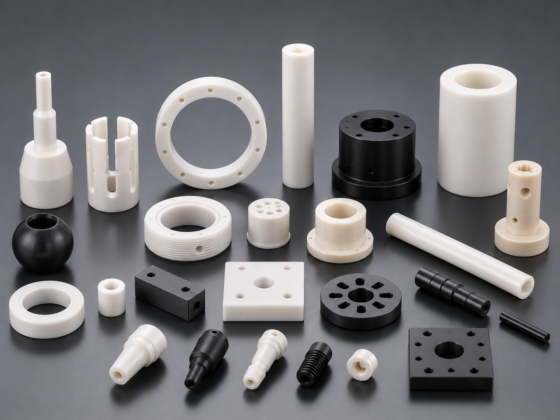
A ceramic flange is a precision-machined component featuring a flange structure used for positioning, sealing, connecting, or supporting mechanical assemblies. Unlike traditional steel or aluminum flanges, ceramic flanges are manufactured from advanced technical ceramics and are designed to withstand aggressive operating conditions.
Through advanced CNC machining, grinding, lapping, and polishing processes, ceramic flange components can achieve tight dimensional tolerances and superior surface finishes, making them suitable for high-precision assemblies.
Common ceramic flange configurations include:
- Flat flanges
- Stepped flanges
- Threaded ceramic flanges
- Vacuum sealing flanges
- Customized precision ceramic flange components
Common Materials Used for Precision Ceramic Flanges
Alumina Ceramic (Al₂O₃)
Alumina is the most widely used engineering ceramic material due to its excellent balance of mechanical and electrical properties.
Key characteristics:
- Haute dureté
- Excellent wear resistance
- Outstanding electrical insulation
- Good corrosion resistance
- Cost-effective manufacturing
Available purity grades typically include:
- 95% Alumine
- 99% Alumine
- 99.5% Alumine
- 99.7% Alumine
Céramique de zircone (ZrO₂)
Zirconia is known for its exceptional toughness and crack resistance compared with other ceramic materials.
Les avantages incluent:
- High fracture toughness
- Superior mechanical strength
- Excellent wear resistance
- Low thermal conductivity
- High dimensional stability
Zirconia ceramic flange parts are often selected for high-load precision assemblies and medical equipment applications.
Nitrure de silicium (Si₃N₄)
Silicon Nitride combines high strength with low density, making it suitable for demanding mechanical applications.
Benefits include:
- High-temperature resistance
- Excellent thermal shock resistance
- Low friction coefficient
- High mechanical reliability
- Outstanding fatigue performance
Carbure de silicium (SiC)
Silicon Carbide offers exceptional hardness and chemical resistance.
Applications typiques incluent:
- Chemical processing equipment
- Pump systems
- Valve components
- Semiconductor manufacturing equipment
Key Advantages of Precision Ceramic Flange Parts
Exceptional Wear Resistance
Engineering ceramics are significantly harder than hardened steel, providing extended service life in abrasive operating environments.
Résistance à la corrosion supérieure
Ceramic materials resist attack from acids, aux alcalis, solvants, and corrosive gases, making them ideal for chemical and pharmaceutical industries.
Electrical Insulation Performance
Unlike metallic flanges, ceramic flanges provide excellent dielectric properties, preventing electrical leakage and improving system safety.
High Temperature Capability
Many advanced ceramic materials maintain their mechanical properties at temperatures exceeding 1000°C, making them suitable for extreme thermal environments.
Conception légère
Certain ceramic materials offer lower density than steel while maintaining excellent strength-to-weight ratios, contributing to equipment efficiency.
Dimensional Stability
Precision ceramic flange parts exhibit minimal thermal expansion and maintain dimensional accuracy under varying operating conditions.
Typical Applications of Precision Ceramic Flange Parts
Industrie des semi-conducteurs
The semiconductor industry requires ultra-clean and highly stable materials for wafer processing and vacuum systems.
Ceramic flanges are commonly used in:
- Vacuum chambers
- Wafer handling systems
- Plasma processing equipment
- Semiconductor inspection devices
Équipements de traitement chimique
Ceramic flanges provide long-term reliability in aggressive chemical environments.
Applications include:
- Chemical pumps
- Flow control systems
- Dosing equipment
- Corrosion-resistant piping systems
Équipements Médicaux et de Laboratoire
Biocompatibility and chemical stability make ceramic components suitable for medical technologies.
Examples include:
- Diagnostic instruments
- Analytical equipment
- Medical fluid systems
- Sterilization equipment
Aérospatiale et Défense
Precision ceramic components help improve reliability under extreme operating conditions.
Common uses include:
- Sensor housings
- Thermal protection systems
- High-temperature assemblies
- Precision positioning mechanisms
Automatisation industrielle
Ceramic flange components contribute to higher precision and longer equipment life in automated manufacturing systems.
Applications include:
- Robotic systems
- Precision motion equipment
- Optical inspection machines
- High-speed assembly equipment
Precision Manufacturing Process
Producing high-quality ceramic flange parts requires specialized manufacturing technologies.
Typical production steps include:
- Ceramic powder preparation
- Pressing or molding
- High-temperature sintering
- CNC machining
- Precision grinding
- Surface polishing
- Dimensional inspection
- Final quality control
Advanced machining capabilities allow ceramic flanges to achieve:
- Tight dimensional tolerances
- Complex geometries
- High concentricity
- Precision sealing surfaces
- Customized mounting features
Custom Precision Ceramic Flange Solutions
Many industrial applications require non-standard ceramic flange designs tailored to specific equipment requirements.
Customization options typically include:
- Outer diameter and inner diameter dimensions
- Flange thickness
- Bolt hole patterns
- Threaded features
- Precision sealing surfaces
- Surface finish requirements
- Material selection
Custom ceramic flange components can be manufactured according to customer drawings, CAD files, or engineering specifications.
Future Trends in Ceramic Engineering Components
The increasing demand for high-performance materials continues to drive innovation in precision ceramic technology. Emerging industries such as electric vehicles, renewable energy systems, semiconductor fabrication, and advanced medical devices are accelerating the adoption of ceramic structural components.
Future developments are expected to focus on:
- Higher precision manufacturing
- Improved ceramic toughness
- Complex custom geometries
- Enhanced surface engineering
- Advanced ceramic composite materials
These innovations will further expand the use of precision ceramic flange parts in next-generation industrial applications.
Conclusion
Precision Ceramic Flange Parts provide a reliable solution for applications where traditional metal components cannot meet performance requirements. Their superior wear resistance, résistance à la corrosion, electrical insulation, and dimensional stability make them indispensable in semiconductor, chimique, médical, l'aéronautique, and automation industries.
Whether manufactured from Alumina, Zircone, Nitrure de silicium, or Silicon Carbide, precision ceramic flange components continue to deliver outstanding performance in the most demanding industrial environments. As technology advances, ceramic engineering solutions will play an increasingly important role in improving equipment reliability, efficacité, and service life.